Introduction: The Living Museum of American Architectural History
New York City is universally celebrated as the global capital of vertical ambition. For more than a century, its skyline has served as a dynamic canvas where the world’s greatest architects, engineers, and visionaries have competed to redefine what human ingenuity can construct from steel, stone, and glass. To gaze upon the Manhattan skyline from across the river, or to stand at the base of a skyscraper looking straight up into the clouds, is to experience a living chronicle of modern human civilization.
From the opulent Gilded Age palaces of Fifth Avenue and the monumental Beaux-Arts majesty of Grand Central Terminal, to the geometric exuberance of Art Deco masterworks like the Chrysler Building and Empire State Building, and the daring 21st-century engineering marvels of the Hudson Yards supertalls, New York’s architectural heritage is unmatched. However, experiencing this vast architectural landscape on foot can be physically exhausting and disorienting. Many of the finest architectural details—gilded elevator doors, terra-cotta gargoyles, carved limestone friezes, and celestial vaulted ceilings—are scattered across different neighborhoods from Lower Manhattan to Upper Harlem.
A private architectural driving tour with Tour to NYC provides the ultimate way to appreciate this urban masterwork. Seated in elevated, climate-controlled comfort with a professional chauffeur navigating smoothly between stops, you can step out directly in front of each iconic facade, photograph intricate details without battling sidewalk crowds, and discover the fascinating historic narratives that shaped New York’s legendary streetscapes.
The Gilded Age & Beaux-Arts Splendor: Classical European Grandeur
Following the American Civil War, the explosive growth of railroads, banking, and industrial manufacturing generated unprecedented private wealth in New York. Wealthy industrialists—the Astors, Vanderbilts, Morgans, and Carnegies—sought to establish New York as the cultural equal of Paris and Rome. They turned to the École des Beaux-Arts in Paris, commissioning grand limestone palaces, civic temples, and public monuments that emphasized symmetry, classical Roman arches, and lavish classical ornamentation.
1. Grand Central Terminal (42nd Street & Park Avenue)
Completed in 1913 by the architectural firms Reed & Stem and Warren & Wetmore, Grand Central is the undisputed crown jewel of Beaux-Arts civic architecture. Its exterior facade features monumental 48-foot arched windows crowned by Jules-Félix Coutan’s massive limestone sculpture *Transportation*, depicting Mercury (god of speed and commerce) flanked by Hercules and Minerva, centered around the world’s largest Tiffany glass clock. Step inside the Main Concourse to admire the vast 125-foot-high vaulted ceiling painted with 2,500 golden stars and zodiac constellations, and marvel at how marble staircases modeled after the Paris Opera House elevate daily transit into an imperial experience.
2. The New York Public Library: Stephen A. Schwarzman Building
Dedicated in 1911 by architects Carrère and Hastings, this marble temple of learning took twelve years to complete and consumed 530,000 cubic feet of Vermont white marble. Guarded by the famous sculpted marble lions, Patience and Fortitude, the building boasts the majestic Rose Main Reading Room—spanning nearly two city blocks with 52-foot gilded ceilings featuring murals of billowing clouds and classical chandeliers.
3. The Plaza Hotel (Fifth Avenue & Central Park South)
Designed by Henry Janeway Hardenbergh in 1907 in the French Renaissance château style, The Plaza’s white glazed brick and steep copper mansard roof have hosted foreign monarchs, presidents, and cultural royalty for over a century. Standing curbside on Grand Army Plaza admiring its monumental scale provides an immediate transport back to the opulent Gilded Age era of F. Scott Fitzgerald and the Jazz Age.
The Golden Age of Art Deco: 1920s Jazz Age Vertigo
The 1920s brought the Roaring Twenties—a decade of unprecedented financial exuberance, technological optimism, and cultural modernity. Architecture cast off classical Roman columns in favor of Art Deco: a radical new style defined by bold geometric forms, stepped ziggurat setbacks, metallic gleam, and aerodynamic decorative motifs celebrating aviation, radio, and electricity.
1. The Chrysler Building (42nd Street & Lexington Avenue)
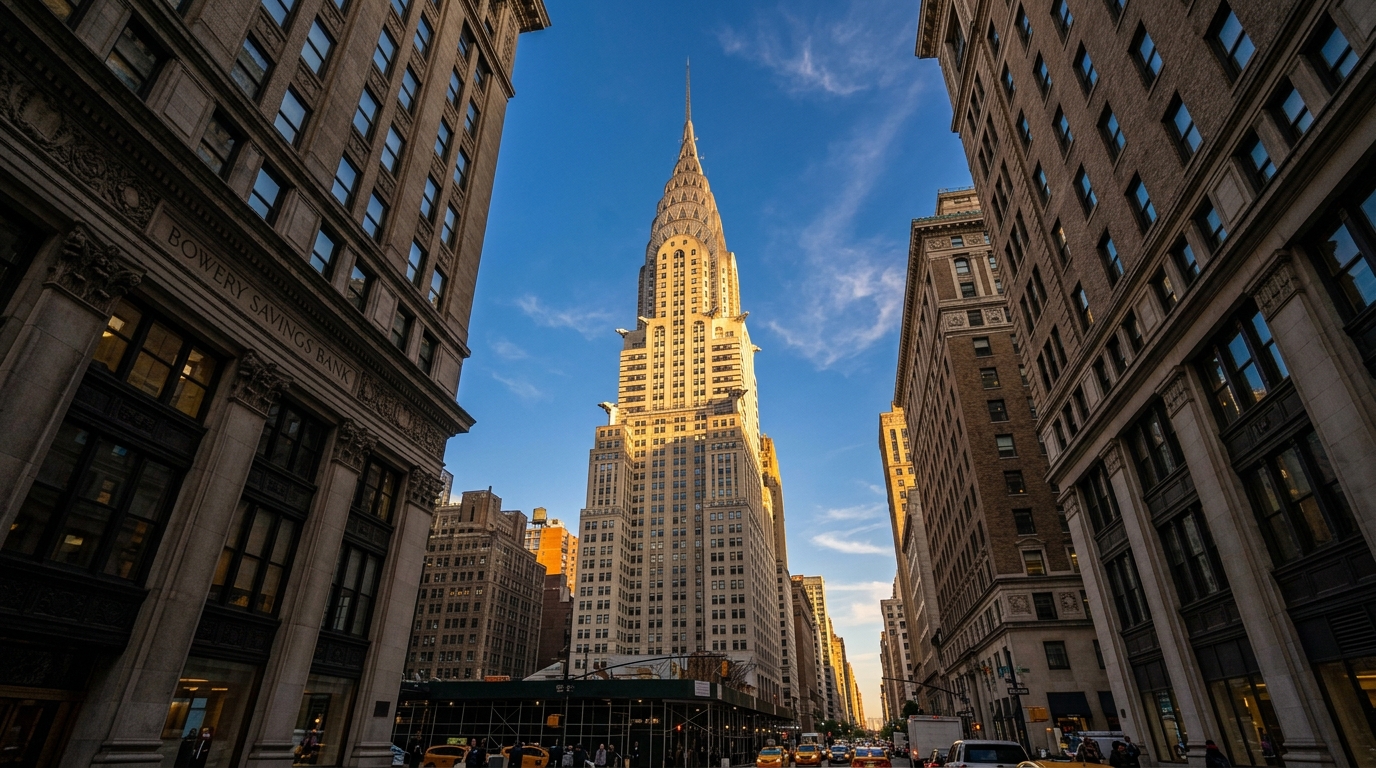
Designed by William Van Alen and completed in 1930, the Chrysler Building is widely regarded by architects as the most beautiful skyscraper ever built. Reaching 1,046 feet, it briefly stood as the tallest structure in the world. Its signature terraced crown features seven concentric sunburst arches clad in gleaming Enduro KA-2 stainless steel, punctuated by triangular lancet windows. Look closely at the setbacks to spot gargoyles modeled after Chrysler automobile radiator caps and abstract winged hood ornaments soaring high above Lexington Avenue. Step into the triangular lobby to view Edward Trumbull’s ceiling mural, rich Moroccan marble walls, and wood-inlaid elevator doors crafted from Japanese ash and walnut.
2. The Empire State Building (34th Street & Fifth Avenue)
Designed by Shreve, Lamb & Harmon and opened on May 1, 1931, the Empire State Building rose in an astonishing one year and forty-five days. Rising 1,250 feet (1,454 feet to the tip of its broadcast spire), it held the title of the world’s tallest building for over forty years. Its clean, fluted limestone facade and symmetrical setbacks represent Art Deco at its most muscular and dignified. The three-story marble lobby features aluminum relief murals depicting the Seven Wonders of the Ancient World alongside the Empire State Building as the Eighth Wonder of the Modern World.
3. Rockefeller Center: The City Within a City
Conceived by John D. Rockefeller Jr. during the darkest days of the Great Depression, this 14-building complex represents the pinnacle of unified Art Deco urban planning. Thirty Rockefeller Plaza (the Comcast Building) anchors the complex, featuring Lee Lawrie’s monumental limestone relief *Wisdom* above the main entrance and Paul Manship’s gilded bronze statue of *Prometheus* leaping over the sunken plaza. Stroll through the Channel Gardens to admire seasonal floral plantings framed by bronze fountain dolphins and soaring limestone verticality.
Mid-Century Modernism & The International Style
Following World War II, New York became the international headquarters of corporate capitalism and global diplomacy. Architecture abandoned decorative ornament entirely in favor of the “International Style”—a philosophy pioneered by the Bauhaus school, characterized by pure structural functionalism, modular glass curtain walls, and exposed steel frameworks.
1. The Seagram Building (375 Park Avenue)
Designed by German master Ludwig Mies van der Rohe and completed in 1958, the Seagram Building is the ultimate textbook definition of modern corporate architecture. Rather than building to the property line, Mies boldly set the bronze-and-smoked-glass tower back one hundred feet from Park Avenue, creating a generous open granite public plaza with twin reflecting fountains. The building’s exterior is detailed with structural bronze I-beams running up the facade, articulating the tower’s verticality with refined, dark elegance.
2. The United Nations Secretariat (First Avenue & 42nd Street)
Designed by an international board of master architects including Le Corbusier and Oscar Niemeyer and completed in 1952, the 39-story Secretariat was the first major skyscraper in Manhattan to utilize a full glass curtain wall. Its flat, green-tinted glass surfaces and marble end walls set on the East River became the visual archetype for modern corporate headquarters worldwide.
The 21st-Century Supertalls: Megastructures & Engineering Feats
The past two decades have witnessed a dramatic renaissance in New York’s skyline, marked by the rise of “supertall” skyscrapers (buildings exceeding 984 feet / 300 meters) utilizing cutting-edge computer-aided engineering, tuned mass dampers, and high-strength concrete.
1. One World Trade Center (Lower Manhattan)
Designed by David Childs of Skidmore, Owings & Merrill and rising a symbolic 1,776 feet into the sky, One World Trade Center is a monumental triumph of architectural resilience and beauty. As the building rises from its cubic bomb-resistant base, its corners taper inward, transforming the square footprint into eight equilateral triangles that meet at an inverted square parapet at the top. The chamfered glass facade reflects the changing light of the sky like a giant multifaceted diamond.
2. One Vanderbilt (Midtown Manhattan)
Standing 1,401 feet directly adjacent to Grand Central Terminal, One Vanderbilt, designed by Kohn Pedersen Fox (KPF), echoes the stepped Art Deco setbacks of its historic neighbors while incorporating state-of-the-art terra-cotta fluting and ultra-clear low-iron glass. Its indoor-outdoor observation experience, Summit One Vanderbilt, features multi-story glass-walled skyboxes projecting out over the street.
3. The Billionaires’ Row Super-Slenders (57th Street Corridor)
Towers like 111 West 57th Street (the Steinway Tower, designed by SHoP Architects) feature an astonishing 24:1 height-to-width aspect ratio, making it the most slender skyscraper in the world. Clad in undulating terra-cotta tiles and bronze filigree, it pays modern homage to New York’s Gilded Age skyscrapers while soaring 1,428 feet above Central Park.
| Architectural Era | Key Timeframe | Signature Landmarks | Defining Characteristics |
|---|---|---|---|
| Beaux-Arts & Gilded Age | 1890 – 1915 | Grand Central, NY Public Library, Plaza Hotel | Limestone symmetry, Roman arches, classical Greek sculptures |
| Art Deco | 1920 – 1939 | Chrysler Building, Empire State, Rockefeller Center | Stepped setbacks, geometric ornaments, stainless steel spires |
| International Style | 1950 – 1975 | Seagram Building, United Nations Secretariat | Glass curtain walls, structural steel I-beams, open plazas |
| 21st-Century Supertalls | 2010 – Present | One World Trade, One Vanderbilt, 111 W 57th | Slender aspect ratios, aerodynamic tapering, high-strength glass |
Secret Architectural Details Most Visitors Overlook
- The Radiator Cap Gargoyles of the Chrysler Building: On the 31st-floor setback, cast-aluminum winged radiator caps project outward from the building corners, modeled directly on the 1929 Chrysler Plymouth roadster.
- The Acorn and Oak Leaf Motifs of Grand Central: Look closely at the bronze light fixtures, carved marble keystones, and ironwork inside Grand Central. The acorn and oak leaf was the official family crest of Cornelius Vanderbilt, symbolizing the proverb: “Great oaks from little acorns grow.”
- The Hidden Murals of Rockefeller Center: Inside the elevator lobbies and concourses of 30 Rockefeller Plaza lie extraordinary murals by José Maria Sert depicting human progress through labor, science, and the arts.
- The Terra-Cotta Grotesques of the Woolworth Building: Completed in 1913 in the Neo-Gothic “Cathedral of Commerce” style, the lobby ceiling arches feature carved humorous caricatures of architect Cass Gilbert holding a model of the building and financier F.W. Woolworth counting nickels and dimes.
The Modern Supertall Revolution: Billionaires’ Row & Modern Engineering
In the twenty-first century, Manhattan’s skyline entered an unprecedented era of vertical ambition known as the ‘Supertall Era’. Advances in ultra-high-strength concrete, digital structural wind modeling, and tuned mass damping technology allowed architects to construct towers of unprecedented height on remarkably narrow footprints along 57th Street, colloquially christened ‘Billionaires’ Row’:
- 111 West 57th Street (Steinway Tower): Designed by SHoP Architects, this breathtaking 1,428-foot residential skyscraper is officially the most slender building in the world, with a width-to-height ratio of 1:24. Its exterior facade is adorned with undulating terracotta tiles and bronze filigree that evoke the golden age of Manhattan skyscrapers while using cutting-edge architectural engineering.
- Central Park Tower (217 West 57th Street): Soaring 1,550 feet above Midtown, Central Park Tower is the tallest residential building on earth. Its sleek reflective glass curtain wall is set back at various intervals to manage high-altitude wind resistance while offering breathtaking 360-degree vistas across Central Park and the entire tri-state region.
- 432 Park Avenue: Designed by Uruguayan architect Rafael Viñoly, this 1,396-foot tower is a minimalist grid of pure geometric concrete squares. Its striking slender profile acts as an austere, modernist exclamation point on the Midtown skyline.
- One Vanderbilt & The Sustainable Future: Standing 1,401 feet directly adjacent to Grand Central Terminal, One Vanderbilt demonstrates how modern supertalls integrate seamlessly with municipal transit infrastructure, incorporating 90% recycled steel and rainwater recovery systems.
Why a Chauffeured Tour is the Ultimate Way to Study NYC Architecture
Appreciating architecture requires the ability to look up, step back across wide avenues to comprehend full building scale, and travel across multiple historic districts without walking miles in between. On a private chauffeured architecture tour, your vehicle stages at the ideal photographic vantage points across Park Avenue, Fifth Avenue, and Wall Street. You step out with your camera, take unobstructed wide-angle shots, examine intricate lobby carvings, and re-enter climate-controlled luxury while your chauffeur navigates to the next masterwork.
Frequently Asked Questions on New York City Architecture
Can we enter the lobbies of historic skyscrapers during our tour?
Yes. Many of New York’s most spectacular Art Deco and Beaux-Arts lobbies—including Grand Central Terminal, the Chrysler Building, Rockefeller Center, and the Woolworth Building—are accessible to the public during normal business hours.
How long should we budget for an architectural sightseeing tour?
We recommend a 4-hour or 6-hour private tour. A 4-hour tour allows you to explore Midtown and Lower Manhattan’s greatest architectural highlights, while a 6-hour tour incorporates historic residential brownstone districts in Greenwich Village, Brooklyn Heights, and Upper East Side Gilded Age mansions.
Can we customize the tour around specific architectural periods?
Absolutely. Whether you want to focus exclusively on Art Deco masterpieces, Gilded Age mansions, or modern sustainable high-rises, our tour specialists will design a custom route tailored to your exact passions.
Conclusion: Book Your Private Architectural Journey with Tour to NYC
New York City’s architecture is a testament to the heights human imagination can reach. Every stone facade, bronze door handle, and soaring glass tower tells a story of triumph, ambition, and historic reinvention.
Experience the architectural wonders of Manhattan from the premier vantage point of a luxury private vehicle. Explore our tailored tour options on Tour to NYC Tours or contact our architectural concierge at Tour to NYC Contact to reserve your private architecture tour today.